
CogniKernel
Local, persistent memory for AI coding-agent sessions.
Pricing
Pricing not verified
- CogniKernel watches coding sessions, extracts decisions and constraints worth retaining, and stores them for a later session. Its memory store is keyed to a project path so the same context can move between supported coding tools in one directory.
- The project documents a deterministic sanitize, classify, and consolidate pipeline for identifying useful session memory. Its stated design uses local fine-tuned encoder models and does not require an API key or a separate generative model for extraction.
- Works with: Claude Code, Codex
What is CogniKernel?
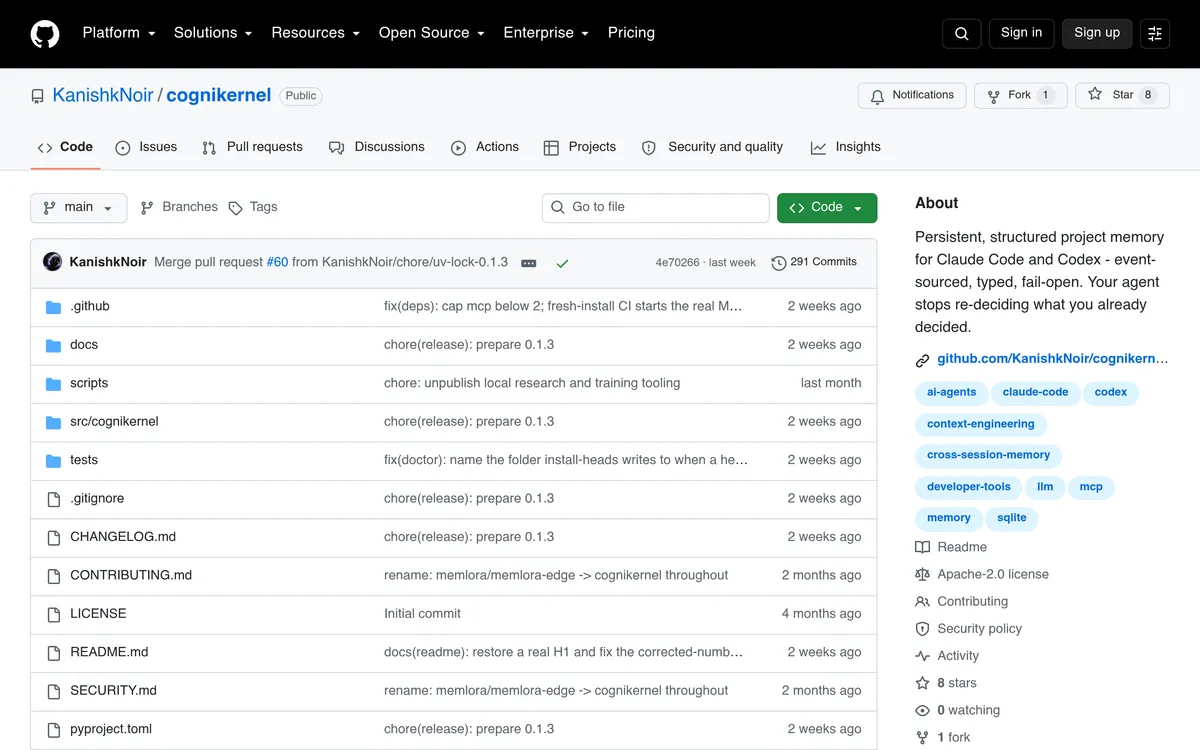
CogniKernel is local memory software for AI coding agents that preserves useful project context between sessions. It captures decisions, constraints, and abandoned approaches, then adds a compact context block when work resumes.
The project treats extraction as classification rather than generative summarization. Its documented local pipeline uses small ONNX encoder models to score salience and detect superseded decisions, without sending session content to a cloud service.
Developers can use it to share one project-path-keyed store across Claude Code and Codex. The tool includes automatic capture and recall, MCP tools for targeted retrieval, and a CLI for setup and maintenance.
CogniKernel is aimed at developers who want coding agents to retain project-specific decisions without continually rebuilding context. Its hooks can surface relevant memory at session start, while prompting, before tools run, and when a session ends.
The software is installed from PyPI and runs locally, making it a fit for teams that prefer to keep coding-session memory on their own machines. Pricing was not verified from the official repository.
Persistent local project memory
CogniKernel watches coding sessions, extracts decisions and constraints worth retaining, and stores them for a later session. Its memory store is keyed to a project path so the same context can move between supported coding tools in one directory.
- The documented store is shared across Claude Code and Codex when they work in the same directory.
Local classification instead of cloud summarization
The project documents a deterministic sanitize, classify, and consolidate pipeline for identifying useful session memory. Its stated design uses local fine-tuned encoder models and does not require an API key or a separate generative model for extraction.
- The repository describes local execution that keeps the session content on the machine.
Hooks for capture, recall, and guardrails
CogniKernel attaches to four points in a coding-agent session, including startup, prompting, tool use, and stopping. This lets it inject a session block, surface relevant memories, warn on past decisions, and persist new decisions after a session.
- The hooks are described as fail-open, so a memory error logs a warning and allows the coding session to continue.
Hybrid retrieval and typed memories
The tool stores typed decisions, constraints, and abandoned approaches instead of only free-text chunks. Its retrieval design combines lexical search with optional dense signals and gives special handling to rules that prohibit a past approach.
- Its retrieval documentation describes a lexical primary search with dense embeddings as an optional fused signal.
Integrations
User reviews
No reviews yet. Be the first to review this tool.
Log in to write a review.
Details on this page are for reference only and may be out of date or inaccurate. Check CogniKernel's official website for current features and pricing.
Join the Aivolut newsletter
Occasional practical AI tips, app updates, and offers. Unsubscribe anytime.