
siift
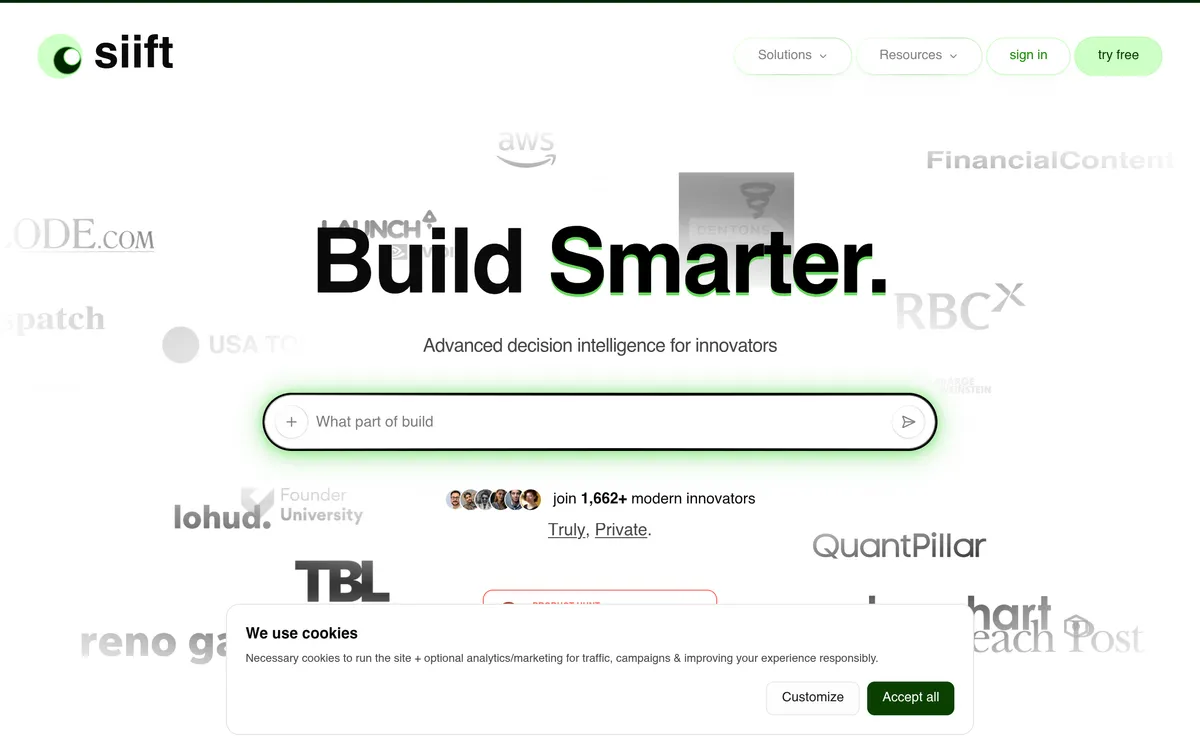
AI workspace for testing business ideas and deciding what to build or launch
MCP integrations
ChatGPT and Claude
Pricing
Pricing not verified
- Explore customer problems, business models, and possible solutions side by side. The canvas ranks options as new evidence comes in.
- Break a business idea into claims and score the market and customer evidence behind each one to see where more research is needed.
- Keep in mind: Software builds planned in siift are implemented separately with coding tools or specialists.
What is siift?
siift gives founders a visual canvas to compare customer problems, market gaps, and possible solutions as evidence comes in. They can start by describing a rough idea in a guided chat that asks about the intended audience and launch market. The AI turns the idea into testable assumptions, scores the evidence behind them, and suggests experiments to fill gaps.
Teams can weigh a manual service, a prototype, or an MVP by cost, technical risk, and what each could teach them. They can set milestones, requirements, and review points for the chosen path, then use the results to refine later build decisions. For a launch, siift helps marketers define the target customer, offer, and channels to test, then update the plan with sales and retention evidence.
Map competing business ideas
- Guided idea chat asks about the intended audience and launch market to give a rough concept more definition.
- Multiple ideas per topic keeps alternatives together so teams can explore different directions without duplicating the canvas.
Decide which assumptions to test
- Audience confidence scoring flags when the intended audience has weak evidence, giving teams a starting point for further research.
- Suggested validation experiments give teams a concrete next test, such as checking whether qualified buyers would pay before committing money.
Scope what to build first
- Build path comparison weighs cost, speed, dependencies, and technical risk across options such as a manual service, a prototype, or an MVP.
- Milestones and review points give teams a place to assess experiment results and use them to update priorities and specifications.
- Briefs and product requirements documents carry the chosen direction into implementation materials that stay linked to the current business context.
Plan and test a launch
- Messaging tied to customer needs gives marketers a basis for choosing which benefits to emphasize in launch copy.
- Offer and channel tests let teams use conversion, sales, and retention results to revise the plan before increasing acquisition spend.
- Research playbooks give teams a starting point for checking competitor gaps or finding online communities relevant to their audience.
Share the reasoning behind decisions
- Layered strategy map lets teammates zoom in on a decision and see how its details connect to the wider strategy.
- Build handoffs give teammates, vendors, and AI agents the outcome, constraints, and trade-offs they need to work toward the same goal.
Diagnose stalled growth
- Growth bottleneck tracking uses the measured result of an intervention to update the evidence and surface the next constraint.
- Pivot impact mapping shows which dependencies a change in strategy could affect so teams can weigh the disruption before changing course.
User reviews
No reviews yet. Be the first to review this tool.
Log in to write a review.
Details on this page are for reference only and may be out of date or inaccurate. Check siift's official website for current features and pricing.
Join the Aivolut newsletter
Occasional practical AI tips, app updates, and offers. Unsubscribe anytime.