
Mechanic AI: How Artificial Intelligence Supports Modern Auto Repair
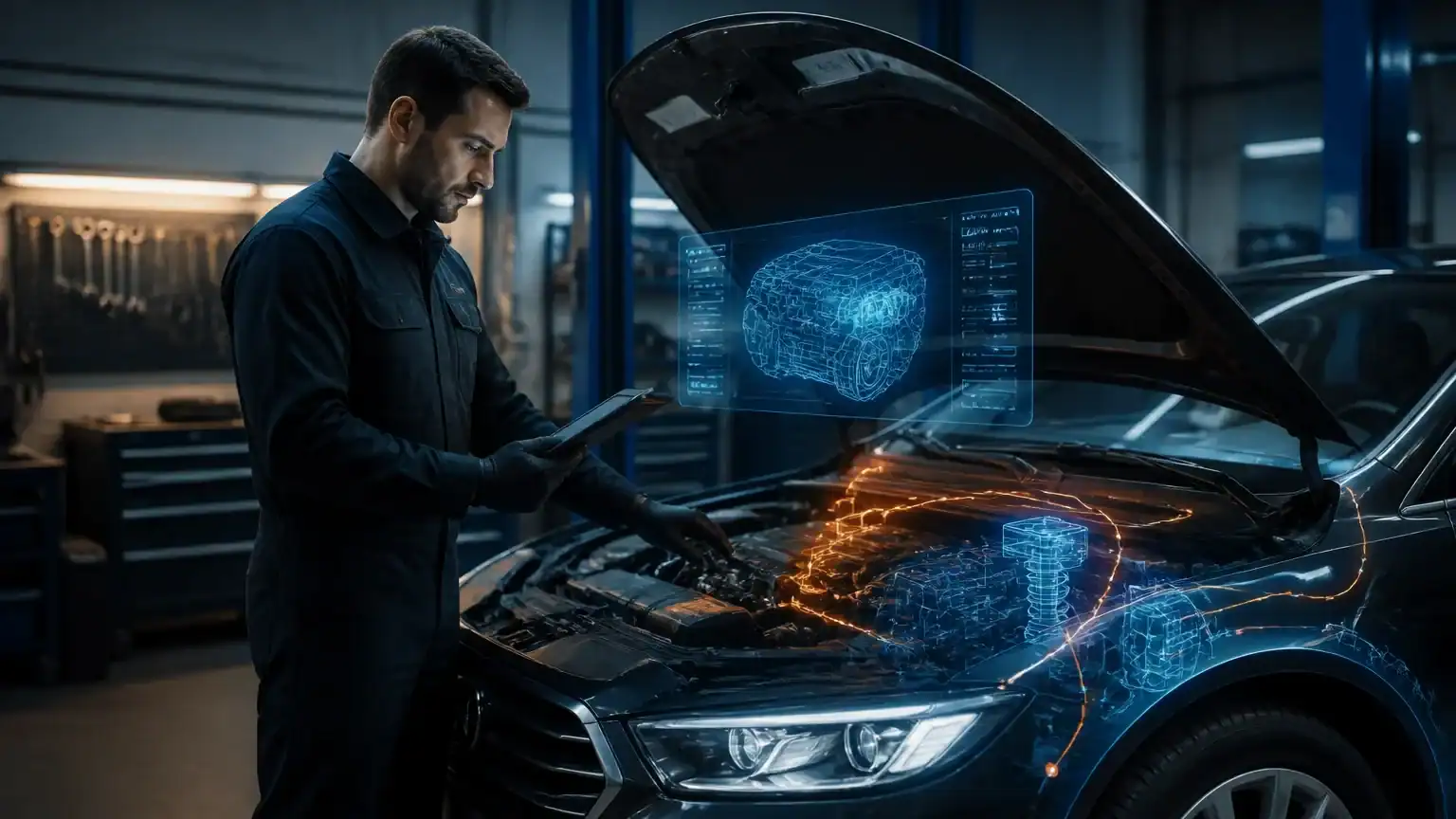
Imagine a customer calling about an intermittent warning light. Before the vehicle reaches the bay, mechanic AI can organize the symptoms, review service history, and suggest likely diagnostic paths. That gives the shop a clearer starting point, even when the problem behaves like a ghost with a check-engine light.
Mechanic AI is not one universal product. It is a growing category of artificial intelligence tools for automotive businesses. These tools may include diagnostic assistants, computer-vision inspection systems, predictive maintenance software, customer chatbots, scheduling platforms, and AI-enabled shop-management systems.
The goal is not to replace trained technicians. AI can spot patterns, summarize information, and handle repetitive tasks, but experienced professionals still verify findings and make critical repair decisions. Think of it as a highly organized assistant—not a robot mechanic rolling under the car with a socket wrench.
For shop owners, marketers, and automotive creators, the opportunity is practical. AI can help improve workflow, shorten response times, personalize customer communication, and support better business decisions. Finding the right tools may begin with an AI tools directory, but successful adoption requires more than choosing the flashiest software.
This article explores realistic use cases, implementation considerations, common limitations, and a practical path for getting started. Whether you run a repair shop or explain automotive technology to customers, you will see where AI can deliver value—and where human expertise remains firmly in the driver’s seat.
How Artificial Intelligence Works in Auto Repair
Mechanic AI begins with data, much like a technician begins with a customer’s complaint. The system may collect diagnostic trouble codes, sensor readings, vehicle make and model, repair histories, technical service bulletins, images, and technician notes. Each piece offers a clue, but the real value comes from connecting them.
Machine learning helps AI recognize patterns across thousands of similar repair cases. For example, a check-engine light paired with a rough idle, a specific oxygen-sensor reading, and a vehicle’s mileage may resemble previous cases involving a vacuum leak. The system does not “remember” the repair like a veteran technician does. Instead, it calculates which patterns most often point toward particular causes.
Natural language processing helps AI understand ordinary shop language. It can interpret notes such as “customer hears a click when turning left” or “brakes feel soft after highway driving.” That matters because technicians rarely write reports like robots—and thankfully, robots rarely write reports like technicians.
Computer vision adds another set of eyes. Given photos or video, AI can help identify worn tire tread, damaged belts, fluid leaks, corrosion, or uneven brake wear. It may also compare an image with known examples. Lighting, camera angle, dirt, and hidden damage can still confuse it, so the tool works best as an assistant rather than an all-knowing garage oracle.
Predictive analytics looks ahead. By combining maintenance history, mileage, driving patterns, and sensor trends, AI can estimate which components may need attention soon. A shop might use that information to recommend a battery test before winter or schedule service for a fleet vehicle before a likely failure causes downtime.
This process differs from conventional software. Traditional automation follows fixed rules: if a code appears, display a predetermined message. AI can interpret messier inputs, weigh multiple clues, and improve its pattern recognition when trained on relevant, reliable data. That distinction also explains whether a calculator is AI: a calculator performs defined operations, while AI typically identifies patterns or makes predictions from complex information.
Still, a useful recommendation is not proof of a mechanical fault. AI might rank a failing ignition coil as the most likely cause, but a technician must inspect the coil, test related circuits, and confirm the result. In practice, the best workflow combines AI’s speed with human judgment. The system narrows the search; the technician verifies what is actually happening under the hood.
The Main Ways Mechanic AI Supports Technicians
Mechanic AI works best as a capable shop assistant, not a digital replacement for the technician. It can organize information, spot patterns, and suggest efficient next steps. The technician still owns the diagnosis, repair decision, and final safety check.
Symptom-Based Diagnosis
The process often begins with a customer’s description. “It shakes when I brake” or “the engine stutters uphill” gives useful clues, but not in a format diagnostic software can easily use.
An AI assistant can translate that description into structured symptoms, such as vibration under braking, speed-related occurrence, and possible heat involvement. It can then rank likely causes and suggest the next tests, such as measuring rotor runout or inspecting brake components.
The ranking helps reduce diagnostic friction. Instead of searching through several systems from scratch, a technician receives a focused list of possibilities. The list is a starting point, not a verdict carved into a very confident-looking tablet.
Technicians must validate those suggestions with scan-tool data, measurements, circuit tests, manufacturer procedures, and physical inspection. A stored fault code may point toward a system without identifying the failed part. Human judgment remains essential.
Repair-Procedure Assistance
AI can also help technicians find and follow repair information. An assistant might surface the correct torque specification, wiring diagram, relearn procedure, fluid type, or manufacturer service bulletin.
This support is especially useful when a repair involves several steps or when procedures vary by model year. The system can summarize relevant instructions and highlight required tools, safety warnings, and follow-up checks.
However, summaries should never replace official service information. Technicians should confirm procedures against current manufacturer documentation. One missing step can turn a quick repair into an expensive encore performance.
Visual Inspection
Computer vision gives mechanic AI another practical role. A technician or service advisor can use images to flag uneven tire wear, body damage, fluid leaks, corrosion, cracked components, damaged belts, and other visible concerns.
For example, an image may show feathered tire tread that suggests an alignment or suspension issue. Another may reveal a coolant leak near a hose connection. These findings can support inspection notes and help explain recommended work to customers.
Visual AI has limits. Poor lighting, blurry images, unusual parts, dirt, and incomplete model coverage can reduce reliability. A camera may identify a suspicious area, but it cannot reliably confirm internal damage or determine whether a component meets safety standards.
Every visual alert requires hands-on confirmation. Technicians should inspect the vehicle directly, use appropriate measurements, and follow safety protocols before recommending repairs.
Knowledge Retrieval
Repair shops manage a large amount of information, from service bulletins and wiring diagrams to past repair records. AI can search that material using plain language and retrieve relevant details quickly.
A technician might ask, “What causes intermittent crank-no-start complaints on this model?” The assistant could surface known failure patterns, diagnostic tests, and related service documents. It may also compare the current symptoms with previous repairs documented by the shop.
A realistic workflow begins when the advisor records the customer’s complaint. AI structures the symptoms and suggests likely causes. The technician reviews those suggestions, performs scans and measurements, and follows the appropriate manufacturer procedure.
After identifying the fault, the technician completes the repair and uses AI to retrieve post-repair checks. Final verification still requires testing the vehicle, clearing and rechecking codes when appropriate, confirming normal operation, and documenting the result. AI speeds the route, but the technician remains in the driver’s seat.
How AI Improves the Customer and Shop Experience
Mechanic AI is not limited to diagnostics and repair-bay decisions. It can also improve what happens before a vehicle arrives and after it leaves. For customers, that means quicker answers, clearer expectations, and fewer calls disappearing into voicemail purgatory.
AI chat and voice assistants can answer common questions about services, pricing ranges, hours, warranties, and vehicle requirements. They can also collect details such as the vehicle’s year, make, model, mileage, warning lights, and symptoms. From there, the system can qualify the request and book an appointment, even when the shop is closed.
That after-hours support matters. A customer searching for help at 9 p.m. may contact the first responsive shop, not the one with the fanciest waiting room. Fast communication can turn an urgent search into a scheduled visit instead of a lost opportunity.
AI can also make repair recommendations easier to understand. Automated estimates and inspection summaries can organize labor, parts, findings, and suggested services in a consistent format. Translation tools can support multilingual customers, while plain-language explanations can replace phrases like “pending fault code” with a clearer explanation of what the code may indicate.
For example, an AI-generated summary might explain that a worn brake pad can reduce stopping performance and damage the rotor if ignored. A technician still reviews the recommendation, but the customer receives useful context without needing an automotive dictionary.
Behind the scenes, AI helps shops manage demand. Forecasting tools can identify busy periods, estimate appointment volume, and reveal when the schedule may exceed available technician capacity. They can also flag appointments with a higher no-show risk, giving staff time to send reminders or confirm details.
Automated messages can handle appointment confirmations, maintenance reminders, estimate approvals, and post-service follow-ups. These messages should feel helpful rather than robotic. “Your vehicle is ready, and here are the checks completed” builds more confidence than a vague “Job complete” notification.
The larger goal is not simply to automate every conversation. It is to create a consistent customer experience, from the first question to the final follow-up. Clear communication helps customers approve needed work, return for maintenance, and recommend the shop to others.
That makes AI-enabled service part of a broader growth strategy. Shops can explore proven customer acquisition techniques while using AI to respond faster and nurture relationships after the initial visit. A new customer may arrive because of an advertisement, but thoughtful follow-up can turn that one repair into a long-term relationship.
In short, AI gives front-office teams more capacity without making customers feel passed around. Staff spend less time repeating information, while customers spend less time wondering what happens next. The technology handles routine communication; people provide judgment, empathy, and the reassuring voice of experience.
Business Benefits of Using Mechanic AI
For an automotive business, mechanic AI can turn routine information work into a faster, more consistent process. It can summarize customer concerns, organize service histories, draft estimates, answer common questions, and suggest appointment times. That gives service advisors and technicians more time for decisions that require human judgment—and fewer battles with overflowing inboxes.
The easiest gains to measure often involve administrative time. Track response time, missed calls, appointment conversion, and hours spent preparing estimates or searching repair information. For example, an independent garage may use AI to respond after hours and collect vehicle details before opening. A small improvement in booked appointments can create revenue without adding another front-desk employee.
Faster diagnostics can also improve bay utilization. AI may surface likely causes, relevant test procedures, or technical service information before a technician begins. The technician still verifies the diagnosis, but less time may be spent hunting through scattered records. Useful measures include diagnostic hours per repair, vehicles completed per bay, cycle time, and comeback rate.
Better explanations can support higher estimate approval rates. An AI-assisted estimate can present the concern, recommended repair, urgency, and likely consequences in plain language. Customers are more likely to approve work when the information feels clear rather than like a ransom note written in socket sizes. Track approval rates, average repair order value, and the time between estimate delivery and customer response.
Customer retention is another potential benefit. Automated updates can notify customers when a vehicle enters the bay, when additional work is found, or when it is ready for pickup. Consistent communication helps build trust, especially when repairs take longer than expected. Monitor repeat visits, review scores, customer satisfaction, and the percentage of customers who return for recommended maintenance.
The right value depends on the business model. A small shop may gain the most from administrative automation and faster customer responses. A dealership may focus on estimate consistency and service-lane throughput, while a mobile mechanic may use AI to plan routes and prepare parts. Fleet operators often prioritize predictive maintenance, fewer roadside failures, and vehicle uptime over higher repair-order value.
Inventory and staffing decisions can improve when the system analyzes repair patterns, seasonal demand, and technician workload. A shop might stock more frequently used parts or schedule an additional technician on busy days. These benefits are usually measured through stockouts, parts turnover, overtime, utilization, and unfilled appointments.
A practical ROI test starts with one costly bottleneck. Estimate its monthly volume and labor cost, then pilot one workflow, such as appointment handling or estimate follow-up. Compare the results against software, integrations, training, and oversight costs. AI does not automatically improve margins; data quality, process design, adoption, and staff trust determine whether the technology helps or merely adds another dashboard to ignore.
Risks, Limitations, and Data-Privacy Considerations
AI can help a shop work faster, but it can also deliver confident nonsense at impressive speed. A mechanic AI system may recommend the wrong component when it lacks vehicle-specific data, recent manufacturer updates, or important diagnostic context. An unusual noise, modified wiring, or a previous repair may change the answer completely.
For example, an AI tool might flag a failing oxygen sensor based on stored codes. The real issue could be an intake leak causing similar symptoms. Technicians should treat AI output as a starting point, not a verdict. Recommendations need testing, inspection, and comparison with reliable service information.
Safety and liability make human oversight essential. Qualified technicians should remain responsible for diagnosis, repair decisions, quality control, and customer disclosure. AI can suggest a path, but it cannot accept responsibility for an improperly repaired brake system or a missed engine fault. That responsibility still belongs with the shop and its professionals.
A strong workflow builds verification into every step. Technicians can require a test result before approving a repair, review unusual recommendations, and document when AI influenced a decision. Human escalation should also be immediate when the system is uncertain, the vehicle presents a safety risk, or the repair falls outside available data.
Privacy creates another important concern. Customer names, phone numbers, vehicle identification numbers, service histories, locations, images, and recorded calls can reveal far more than a shop may realize. Sending that information to an AI vendor without clear safeguards could expose customers, employees, and the business to unnecessary risk.
Before adopting a tool, ask vendors how long they retain data and whether customer information trains their models. Review access controls, encryption, audit logs, integration permissions, deletion processes, and breach-response procedures. Confirm who can view diagnostic images, call transcripts, and customer records. A free trial should not become a permanent data pipeline by accident.
It is also wise to examine compliance obligations that may apply to customer communications, payment information, recordings, or regional privacy laws. Contracts should define data ownership, permitted uses, security responsibilities, and what happens when the relationship ends. If a vendor cannot explain its data practices plainly, that is a warning light worth checking.
The idea of sovereign AI and data control offers a useful lens here. It asks where sensitive information is processed, which laws govern it, and whether it remains within the organization’s chosen environment. For some repair groups, local or private deployment may provide stronger control than sending every record to a public cloud.
Responsible deployment does not mean avoiding AI. It means giving the technology clear boundaries, reliable information, and a human in the loop. In other words, let AI hold the flashlight—but keep a qualified technician under the hood.
How to Choose and Implement Mechanic AI
Choosing mechanic AI should begin with the workflow, not the sales demo. Document where delays, repeated customer questions, missed follow-ups, diagnostic bottlenecks, and inconsistent notes cost the business time or money. If advisors spend every morning answering “Is my car ready yet?” an appointment and status tool may help more than an advanced diagnostic assistant.
Next, compare standalone AI tools with features already built into your current platforms. Shop-management, dealership, diagnostic, CRM, digital inspection, and fleet-maintenance systems may offer AI capabilities without adding another login. A standalone product could provide deeper specialization, but it may also create duplicate data entry—because apparently one dashboard was not enough.
Evaluate each option against your real operating conditions. Check its integration with scheduling, customer records, repair orders, parts systems, and diagnostic equipment. Also review ease of use, vehicle-data coverage, explanation quality, customization, mobile access, vendor support, pricing, security, and data export options. Your business data should remain accessible if you change providers later.
Ask vendors how the system reaches its recommendations. Can a technician see the diagnostic sources, service information, or logic behind an answer? An AI that says “replace this component” without showing its reasoning is less useful than one that identifies possible causes and suggests verification steps. Vehicle coverage matters, too; a clever tool that lacks information for the models you service is clever in theory only.
Start with a small pilot instead of attempting full-shop automation. Good first projects include service-request triage, inspection-report drafting, appointment reminders, or technician knowledge search. Select a process with clear boundaries and limited safety risk. For example, AI can draft an inspection summary, while an advisor checks accuracy before sending it to the customer.
Define success before the pilot begins. Track response time, follow-up completion, documentation quality, diagnostic research time, customer satisfaction, and labor savings. Create human-review rules that specify when employees should trust, verify, override, or report an AI recommendation. A technician might use AI to rank likely causes, but must verify the fault through testing before authorizing a repair.
A practical adoption plan can follow three stages. During the first 30 days, establish a baseline, choose the pilot, configure permissions, and train the team. Explain both the benefits and the boundaries; staff should know that AI is an assistant, not a newly licensed technician.
During days 31 through 60, run the pilot with real work and review its outputs regularly. Record useful answers, errors, delays, and employee feedback. Encourage staff to report problems without fear, since hidden mistakes grow faster than weeds in a neglected parking lot.
During days 61 through 90, compare results with the baseline. Expand only when the pilot shows measurable value without lowering repair quality, customer trust, or team efficiency. If the results are mixed, adjust the workflow or vendor rather than forcing adoption. The goal is not the most AI; it is a safer, faster, more consistent shop.
Frequently Asked Questions About Mechanic AI
Can mechanic AI diagnose a car by itself?
Not reliably—and it should not try. Mechanic AI can analyze symptoms, diagnostic trouble codes, service records, sensor readings, and technician notes. It can then suggest likely causes or recommend the next test.
However, a suggestion is not a diagnosis. A system might flag an ignition coil based on a misfire code, but a technician still needs to inspect the coil, test related circuits, and confirm the fault. Think of AI as a fast research assistant, not a robot with a wrench.
Is mechanic AI only for large dealerships?
No. Independent repair shops can start with affordable, narrow applications. Scheduling, appointment reminders, customer messaging, inspection reports, and searchable repair knowledge are often practical first steps.
For example, a small shop might use AI to turn technician notes into a clear customer-facing inspection summary. That saves time without requiring a massive data system or a fleet of software engineers. Start with one recurring headache, then measure whether the tool actually helps.
Will AI replace auto mechanics?
AI is more likely to replace repetitive tasks than skilled technicians. It can automate documentation, information retrieval, estimate follow-up, and routine communication. It cannot easily replace physical inspection, hands-on repair, judgment under uncertainty, or accountability for a vehicle’s safety.
A technician still decides whether a repair is appropriate and confirms that the vehicle works afterward. AI may help find the service procedure faster, but it cannot take responsibility for a loose ground wire. That job still belongs to someone with training—and preferably a torque wrench.
How accurate is mechanic AI?
Accuracy depends on the task, data quality, vehicle coverage, software design, and validation process. A tool may be highly reliable when summarizing an inspection, yet less dependable when ranking complex electrical faults.
Shops should monitor recommendations instead of accepting them blindly. Compare AI suggestions with technician findings, track incorrect recommendations, and review performance across different vehicle makes and conditions. Confidence scores can help, but confidence is not proof.
What data does a mechanic AI tool need?
The answer depends on the application. Useful information may include vehicle make, model, year, mileage, diagnostic codes, service history, technician observations, inspection images, parts information, and customer interaction data.
Better data usually produces better results, but more data is not always better. Shops should collect only what the tool needs, control employee access, and protect customer and vehicle information. Remove unnecessary personal details where possible, and understand how vendors store, process, and share the data.
Can creators and marketers use mechanic AI too?
Yes. Creators can use it to explain technical topics in plain language, while marketers can personalize maintenance reminders or develop service content. Human review remains important, especially when advice could affect safety, cost, or customer trust. A polished wrong answer is still wrong—just wearing a nicer jacket.
The Practical Future of AI in Auto Repair
Mechanic AI is best understood as an augmentation layer for skilled people and well-designed processes. It can organize repair information, recognize patterns in diagnostic data, automate customer communication, and predict operational needs. It cannot replace inspection, experience, ethics, or accountability.
The strongest results come from practical workflows. AI might flag a likely ignition problem, suggest a follow-up message, or identify parts that need ordering. A qualified technician still confirms the diagnosis, performs the repair, and verifies the vehicle. The technology can hold the flashlight, but people still work under the hood.
For businesses considering adoption, start with one measurable problem. Choose a workflow such as estimate follow-up, appointment scheduling, or parts forecasting. Establish a baseline, protect customer and vehicle data, and keep human oversight in place. Then measure time saved, conversion rates, repair quality, customer satisfaction, and risk before expanding. An impressive tool without a defined use case is usually just an expensive dashboard wearing a futuristic hat.
Owners should measure both ROI and risk before approving broader deployment. Marketers should use AI to improve customer communication, consistency, and retention—not to replace trust. Creators should explain AI’s real capabilities without hype, especially when safety and repair costs are involved. For continued research, explore a broader AI tools directory, then choose solutions based on workflow fit, data protection, integration, and human review. The practical future is not AI instead of expertise. It is AI helping good teams work smarter, communicate better, and repair vehicles more reliably.
Related Articles

Industrial AI: Applications, Benefits, and Real-World Challenges Explained
Imagine a production line that pauses for maintenance before a motor fails—not after sparks fly and orders pile up. That is industrial AI in action: using ma…
Read more
AI for Engineers: 9 Practical Ways to Improve Daily Workflows
AI for engineers is less about handing over the controls and more about removing friction from the workday. Used well, AI can summarize technical discussions…
Read more
AI Architecture Diagram: Key Components and How to Read Them
A business owner opens an AI architecture diagram and sees boxes labeled “model,” “API,” “database,” and “workflow.” It looks a little like a subway map desi…
Read more