
RPA vs AI: Key Differences to Boost Your Business Efficiency
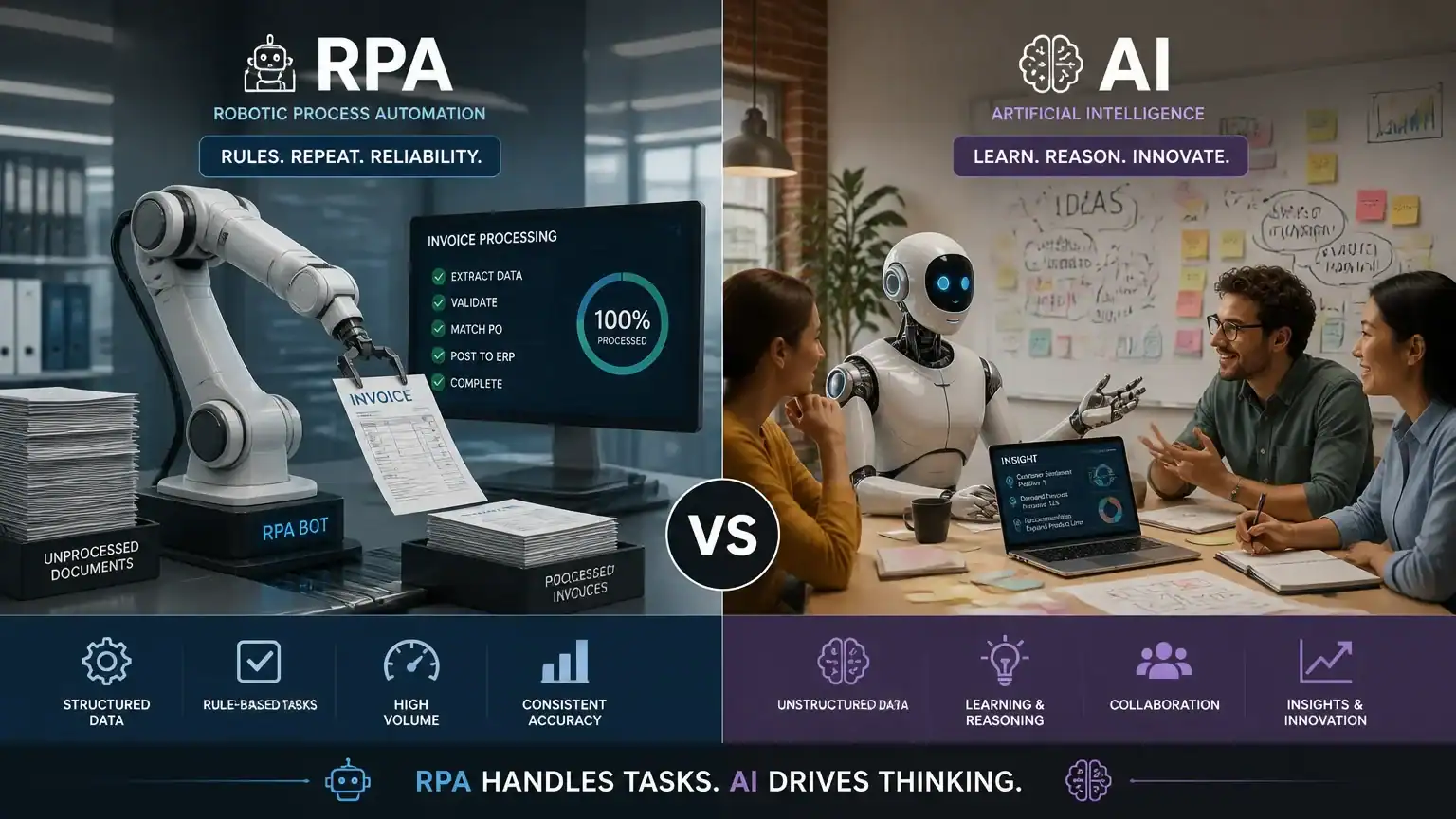
In today’s fast-paced business world, understanding the difference between RPA and AI is crucial for enhancing efficiency. Robotic Process Automation (RPA) automates repetitive tasks, like data entry or invoice processing, freeing up human workers to focus on more complex challenges. Imagine RPA as a diligent office assistant who never complains about doing the same task over and over, while you tackle the big-picture issues.
On the flip side, Artificial Intelligence (AI) mimics human intelligence, enabling machines to learn and make decisions. Think of AI as a savvy consultant who analyzes data trends and provides insights, often surprising you with its clever recommendations.
As businesses increasingly adopt these technologies, the lines between RPA and AI can blur. Both are essential for streamlining operations, but they serve distinct purposes. This article will explore their differences, helping you determine which solution best suits your business needs. For those looking to dive deeper into the world of AI, check out Aivolut’s directory of AI tools. By the end, you’ll have a clearer picture of how RPA vs AI can elevate your efficiency and productivity.
Understanding RPA: The Basics
Robotic Process Automation (RPA) is like having a virtual assistant who never takes a coffee break. It automates repetitive tasks, allowing businesses to save time and reduce errors. Imagine having a tireless worker who can handle mundane data entry, invoice processing, and report generation—this is RPA in action.
One of the key features of RPA is its ability to mimic human actions. It can log into applications, move files, and extract data, all while following specific rules. Think of RPA as a digital puppet, deftly pulling the strings of your business processes. This technology can significantly enhance productivity, freeing your human employees to focus on strategic tasks that require creativity and decision-making.
Implementing RPA comes with a myriad of benefits. For starters, companies can experience a rapid return on investment. Many businesses report a 30% increase in efficiency soon after integrating RPA. Plus, it helps maintain consistency in processes, reducing the likelihood of human error. This means fewer headaches for your team and happier clients, as processes become more reliable.
Industries that benefit the most from RPA include finance, healthcare, and retail. In finance, it streamlines tasks like transaction processing and compliance reporting. In healthcare, RPA can manage patient records and appointment scheduling, allowing medical staff to focus on patient care. Retailers use RPA to manage inventory and process orders efficiently.
In summary, RPA is a game-changer for businesses looking to improve efficiency. By automating routine tasks, companies can not only save time and resources but also enhance overall productivity. As we delve deeper into the RPA vs AI discussion, it’s essential to recognize how RPA is uniquely positioned to transform operations across various industries.
What is AI: A Comprehensive Overview
Artificial Intelligence (AI) is like the Swiss Army knife of technology—versatile and capable of performing a variety of tasks. At its core, AI refers to machines that can simulate human intelligence to perform tasks and improve over time. But not all AI is created equal; it can be broadly categorized into narrow AI and general AI.
Narrow AI, or weak AI, is designed for specific tasks. Think of it as a highly skilled barista who can whip up the perfect latte but wouldn’t know how to make a soufflé. Examples include chatbots, recommendation algorithms, and image recognition systems. These tools are reshaping decision-making processes in businesses by analyzing data and providing insights that humans might miss.
On the flip side, general AI, or strong AI, is the Holy Grail of AI development. It aims to replicate human cognitive abilities, enabling machines to understand context and make decisions as a human would. While we’re not quite there yet, advancements in this area could revolutionize industries, from healthcare to finance.
AI’s impact on data-driven decision-making is profound. Businesses harness AI to sift through mountains of data, uncovering trends and insights that drive strategy. For instance, retail giants use AI to predict customer preferences, leading to tailored marketing strategies that boost sales.
Diverse applications of AI span various sectors. In healthcare, AI analyzes patient data to recommend treatments. In finance, it detects fraudulent transactions before they happen. Even agriculture benefits, with AI predicting crop yields based on weather patterns.
For a fascinating look into future developments, check out Exploring Eternal AI in 2026. Understanding these differences between RPA and AI will help you decide which technology can best enhance your business efficiency.
Key Differences Between RPA and AI
At first glance, RPA (Robotic Process Automation) and AI (Artificial Intelligence) might seem like two peas in a tech pod, but they serve very different purposes. Think of RPA as a diligent office intern who tirelessly processes forms, while AI is the innovative strategist who analyzes data and provides insights. One focuses on automation, and the other on intelligence.
RPA operates on rules. It excels in repetitive tasks, like data entry or invoice processing, where the steps are clear-cut and predictable. For example, if you need to extract data from emails and input it into a spreadsheet, RPA can handle that without breaking a sweat—like a robot that’s mastered the art of copy-pasting.
On the other hand, AI thrives on patterns and learning from data. It can analyze vast amounts of information, recognize trends, and make predictions. Imagine AI as a seasoned detective who sifts through clues to solve mysteries. For instance, AI can analyze customer behavior to recommend products, turning casual shoppers into loyal customers.
Another key difference lies in adaptability. RPA is like a well-trained dog—it follows commands without deviation. If a new process comes along that doesn’t fit its script, RPA struggles. In contrast, AI is more like a cat. It learns, adapts, and evolves based on its experiences, making it invaluable for complex decision-making scenarios.
In summary, while RPA is your go-to for efficiency in repetitive tasks, AI brings the power of data-driven insights and adaptability. Understanding these nuances in the RPA vs AI debate can help your business harness the right tool for the job, ultimately leading to enhanced efficiency and productivity.
Combining RPA and AI for Maximum Efficiency
Integrating Robotic Process Automation (RPA) and Artificial Intelligence (AI) can create a powerhouse of business efficiency. Think of it as combining the reliable, hard-working bee (RPA) that tirelessly gathers nectar with the clever, innovative honey maker (AI) that turns that nectar into something sweet. Together, they can produce a honeycomb of streamlined processes that boosts productivity.
Take the example of a financial services company that implemented both RPA and AI. By using RPA to automate repetitive data entry tasks, they freed up employees to focus on more strategic initiatives. Meanwhile, AI analyzed market trends and customer behavior, providing insights that enhanced decision-making. The result? Increased efficiency and a significant boost in revenue.
A hybrid approach offers several benefits. RPA handles structured tasks with speed, while AI tackles unstructured data and makes predictions. This means businesses can not only automate mundane processes but also gain valuable insights to drive growth. Imagine a shipping company using RPA to track deliveries and AI to optimize routes based on real-time traffic data. The efficiency gains could be astronomical!
However, combining these technologies isn’t without challenges. Integrating RPA and AI requires careful planning and expertise. Organizations may face hurdles in aligning their existing systems or ensuring data quality. Moreover, employees might initially resist these changes, fearing job displacement. It’s crucial to communicate that RPA and AI are here to enhance their roles, not replace them.
In summary, the synergy of RPA and AI can lead to unparalleled efficiency and productivity. By leveraging the strengths of both technologies, businesses can navigate the complexities of modern operations while staying ahead of the competition.
Conclusion: Making an Informed Choice
Understanding the differences between RPA and AI is crucial for businesses looking to enhance efficiency. RPA excels at automating repetitive tasks, while AI offers insights and adaptability. Think of RPA as a reliable, clockwork assistant, tirelessly churning out tasks without a coffee break. In contrast, AI is like a savvy, data-driven consultant, ready to adapt to new information and provide strategic recommendations.
As a business owner, consider your specific needs carefully. Are you drowning in repetitive tasks that drain time? Then RPA might be your best bet. Or are you looking to leverage data for smarter decision-making? In that case, AI could be your secret weapon. The key is to align the technology with your operational goals.
Looking ahead, the future of RPA and AI in business is bright. These technologies will continue to evolve, creating new opportunities for efficiency and productivity. If you’re curious about how to leverage these advancements, check out resources like How to Make Money with AI for business insight. By making an informed choice between RPA vs AI, you can position your business for success in an increasingly competitive landscape.
Related Articles

Is Character AI Generative AI? How It Works and What It Creates
Is Character AI generative AI? Yes. It creates original text responses from your prompts, conversation context, and patterns learned during training. Instead…
Read more
I for One Welcome Our AI Overlords: Meaning, Origin, and AI Culture
“I for one welcome our AI overlords” sounds like a joke because it is one—usually. The phrase signals ironic enthusiasm, reluctant acceptance, or humorous su…
Read more
What Are AI Skills? Essential Abilities for Today’s Workplace and Business
If you’ve wondered, what are AI skills, the answer goes beyond coding or building robots. AI skills are the practical abilities to understand what AI can do,…
Read more