
Service Oriented Architecture Examples Explained With Real-World Use Cases
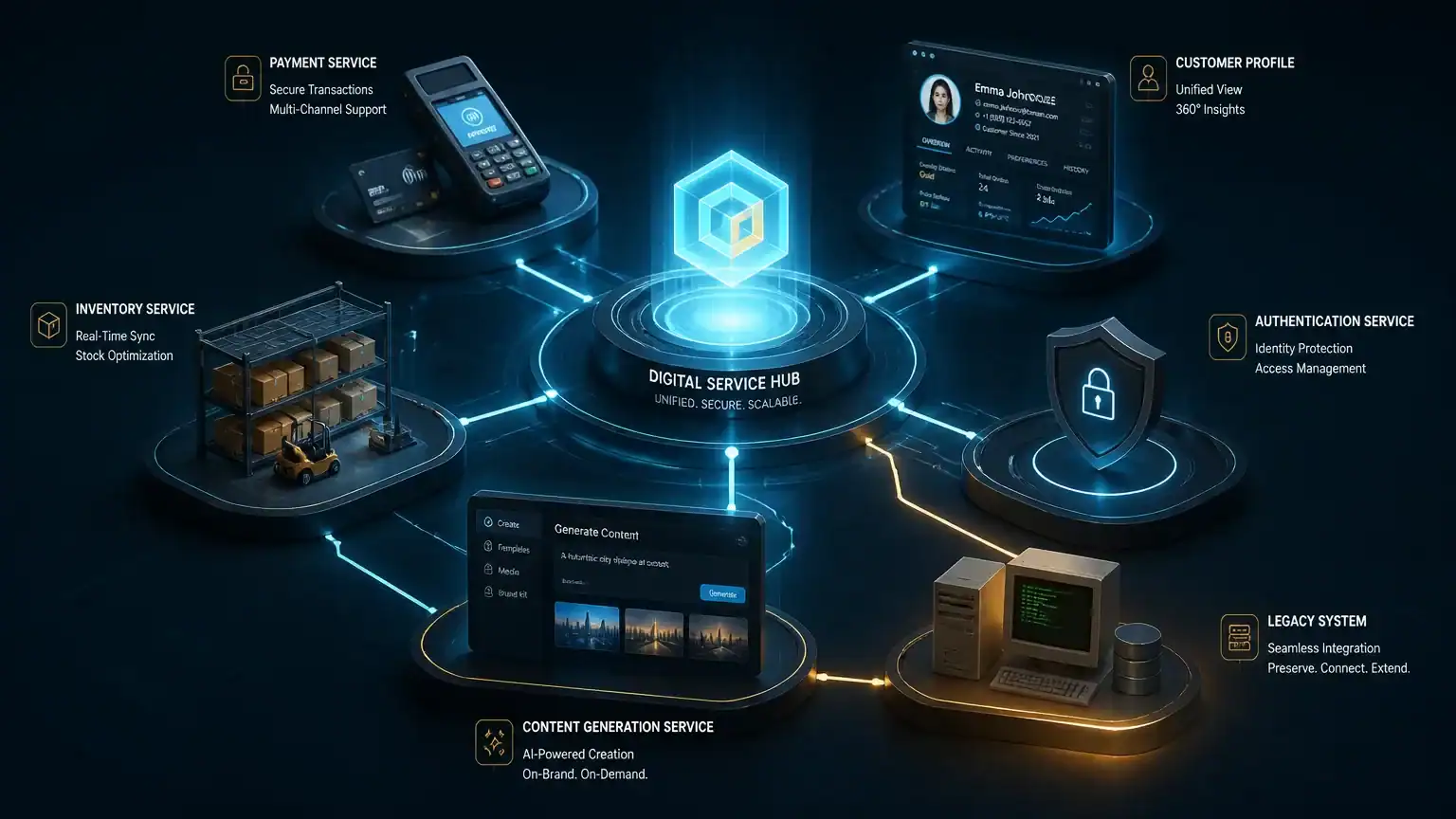
Service oriented architecture examples show how businesses replace one tightly connected application with independent, reusable services. Each service handles a focused capability, such as payments, customer profiles, inventory, authentication, or content generation. It communicates with other systems through clear contracts, much like departments using agreed forms and processes.
This structure makes integration easier, updates faster, and duplicated work less common. It can also connect older systems with newer AI-powered tools, without forcing a complete platform rebuild. As organizations embrace the growing role of AI in business operations, SOA provides the framework for combining specialized technologies smoothly. The following real-world use cases show how these services work together—and why that flexibility matters.
Example 1: E-Commerce Order Processing
An online store may look like one polished website, but several services work behind the scenes. The product catalog service displays items and prices, while the cart service stores each shopper’s selections. During checkout, the payment service authorizes the transaction, and the inventory service reserves the products.
After payment succeeds, the shipping service prepares delivery details. A notification service then sends the customer an order confirmation, tracking updates, or the occasional “your package is taking the scenic route” message. Together, these services create one smooth experience, even though each handles a different task.
This setup is one of the most practical service oriented architecture examples. Teams can update services independently. For example, they might add a new payment provider without rewriting the storefront or shipping logic, much like adding WordPress plugins that extend blog functionality without rebuilding a website.
Business owners gain fewer checkout failures, easier scaling during promotions, and clearer troubleshooting. If payments fail, teams can investigate that service directly. The trade-off is coordination: reliable communication, consistent data, authentication, and monitoring must span every service.
Example 2: Manufacturing and ERP Integration
Imagine a manufacturer receiving a large new customer order. An order service shares the demand with inventory, procurement, production planning, warehouse, and logistics services. Each service performs its role, then returns updates so teams can track materials, schedules, and delivery progress without passing spreadsheets around like office hot potatoes.
Here, ERP is the business system being connected, while SOA is the integration approach. Service boundaries let the company preserve a legacy ERP while adding modern dashboards, supplier portals, workflow automation, or AI forecasting tools. For organizations comparing top ERP systems for manufacturing, this distinction matters: the ERP manages core business data, while SOA helps other tools communicate with it.
When inventory reports a shortage, procurement can contact suppliers automatically. Production planning can adjust schedules, and logistics can prepare a realistic dispatch date. These coordinated services improve stock visibility, speed up order updates, reduce manual data transfers, and make production planning more responsive.
This is one of the most practical service oriented architecture examples because manufacturers can modernize gradually. They can replace or improve individual services without rebuilding the entire ERP foundation—keeping operations moving while technology catches up.
Example 3: Ride-Sharing and On-Demand Mobility
A ride-sharing platform may look like one app, but it behaves more like a busy digital orchestra. Separate services manage user accounts, driver availability, geolocation, trip matching, pricing, payments, notifications, and customer support.
Here’s the real-time flow: a rider requests a trip through the account service. The location service identifies nearby drivers, while the matching service assigns the best available option. Pricing calculates the fare, payment completes the transaction, and notification services keep both people updated.
Independent services matter because demand can change dramatically across cities, weather conditions, or major events. Location and matching may need extra capacity during rush hour, while account management remains relatively stable. Scaling only the busiest services avoids treating the entire platform like it needs a turbocharger.
This flexibility also supports experimentation. Teams can test a new pricing model or recommendation feature without destabilizing payments, accounts, or trip tracking. For additional tech insights from Uber-style mobility platforms, similar principles appear across modern transportation systems.
The same model supports delivery companies, appointment marketplaces, event ticketing, and other platforms coordinating many users and transactions. These service oriented architecture examples show how independent components can work together while remaining easier to scale, improve, and troubleshoot.
Example 4: AI-Powered Content and Marketing Workflows
Creators and marketing teams can use SOA to connect specialized tools without adopting one giant platform. A content brief enters a planning service, which organizes the audience, topic, keywords, and publishing schedule. An AI writing service then drafts the article, email, or social post.
Next, a brand-check service reviews tone, terminology, accessibility, and required disclosures. After human approval, a publishing service distributes the content across websites, newsletters, and social channels. An analytics service measures traffic, engagement, conversions, and audience responses, while a customer data service helps personalize future campaigns.
This setup makes one of the most flexible service oriented architecture examples for small teams. If an AI provider becomes expensive or produces weaker results, the team can replace it behind the same service interface. The surrounding workflow does not need a dramatic redesign—no digital dominoes required.
SOA improves coordination, but it does not replace human judgment. People must verify facts, review copyright and privacy risks, check brand safety, and make final approval decisions. Teams exploring software engineering projects that explore practical systems can model this workflow with separate services, clear APIs, authentication, and monitoring.
When SOA Makes Sense for Your Business
These service oriented architecture examples point to a clear pattern: SOA works best when multiple systems, recurring integrations, changing requirements, or specialized tools must work together. Independent services improve flexibility, reuse, and troubleshooting, but they also demand governance, documentation, security, testing, and monitoring.
For business owners, marketers, and creators, start small. Choose one high-value workflow, define clear service boundaries, and measure the operational benefit. Expand only when the added flexibility justifies the complexity—because even smart architecture should earn its keep.
Related Articles

Mechanic AI: How Artificial Intelligence Supports Modern Auto Repair
Imagine a customer calling about an intermittent warning light. Before the vehicle reaches the bay, mechanic AI can organize the symptoms, review service his…
Read more
What Is AI Engineering? Roles, Skills, Tools, and Career Paths
If you’ve wondered what is AI engineering, think of it as the bridge between clever AI ideas and useful business systems. AI engineers design, integrate, tes…
Read more
Transforming Electronics: How AI Circuit Design is Revolutionizing Development
The world of electronics is on the brink of a revolution, thanks to advancements in AI circuit design. Imagine a world where engineers no longer spend countl…
Read more